
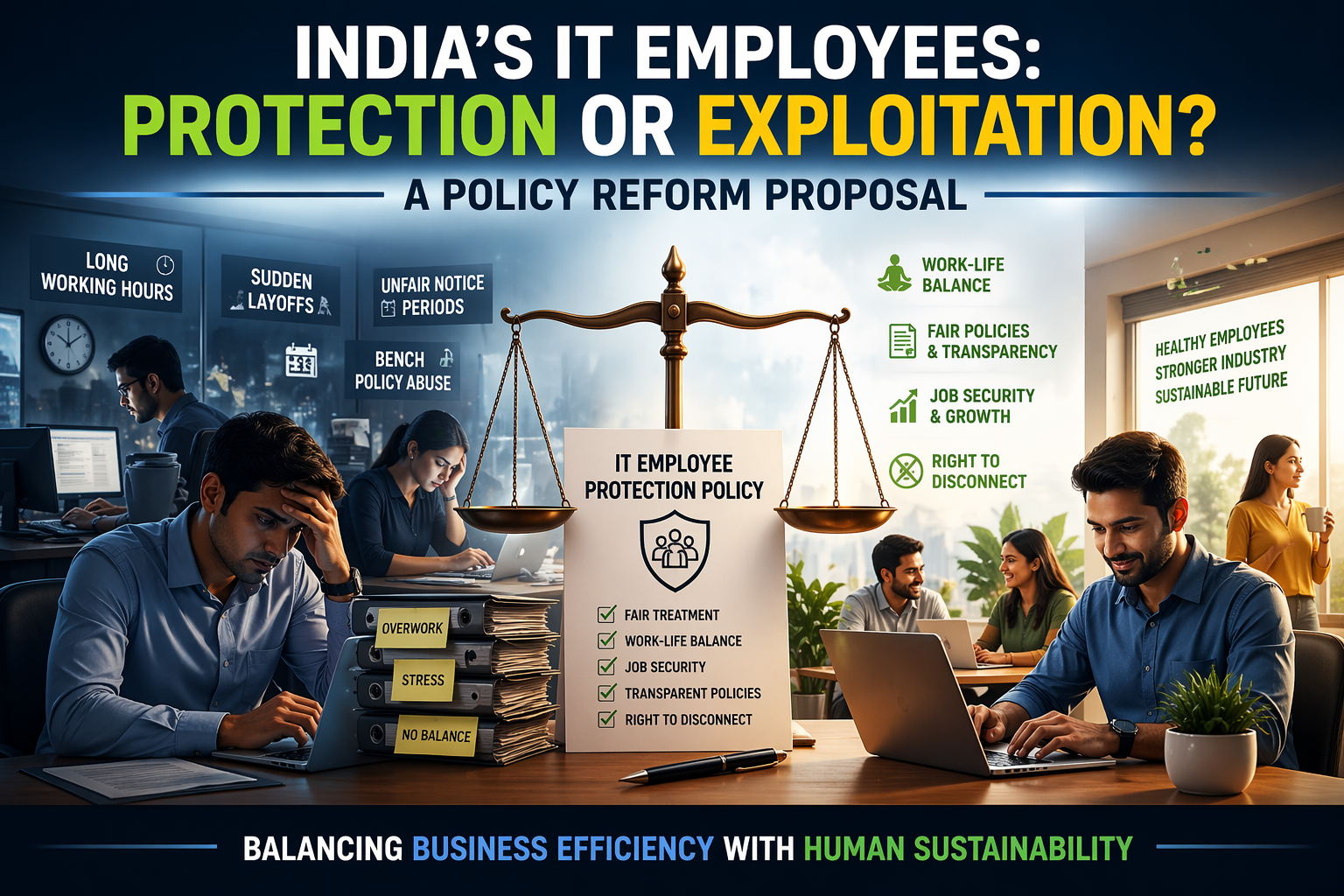
What happens when one of India’s most powerful industries grows faster than the policies designed to protect its people?
This is not a criticism of companies — it is a call for balance between business efficiency and human sustainability.
In this article:
Millions of professionals contribute significantly to global technology services, making the IT sector one of the strongest pillars of India’s economy. However, despite its growth and success, IT employees often face serious challenges related to job security, fair treatment, and work-life balance.
Having worked closely with production systems, critical deployments, and high-pressure IT environments, I have seen these challenges not just as an observer—but as a participant in the system.
Across the industry, extended working hours, sudden layoffs, and contract-heavy employment structures are becoming increasingly common. While legal frameworks exist, their application to white-collar IT professionals is inconsistent. This highlights the urgent need for a dedicated IT Employee Protection Policy in India.
⚠️ Key Policy Challenges Faced by IT Employees
1. Sudden Layoffs
Termination through abrupt emails without prior discussion, PIPs, or justification, leading to immediate financial instability and mental stress.
2. Unpaid Overtime Culture
Employees frequently work beyond standard hours without overtime pay or compensatory leave, often justified under “client requirements.”
3. Bench Policy Exploitation
If no project is allocated, indirect pressure is created to force resignation—without formal accountability from the company.
4. Project-Based Insecurity
Permanent employees are often treated as project-based resources; when a project ends, job stability becomes uncertain.
5. Unfair Notice Periods
A significant imbalance where companies demand immediate joiners but enforce long notice periods (60–90 days) during resignation.
6. Forced Retention
Enforcing full notice periods even when handover is complete reflects rigidity rather than actual business requirements.
⚠️ Workplace Reality: Management & Culture Issues
Beyond policies and contracts, a major challenge in the IT industry is the day-to-day work culture, which directly impacts employee well-being and performance.
Teams operate with insufficient manpower, leading to long working hours (“long seating”) and excessive dependency. Junior employees bear the majority of the workload, resulting in burnout.
Projects are assigned with tight deadlines. A lack of proper planning leads to inevitable delays. Job security threats are used as pressure tactics, creating a fear-driven environment.
Decisions are often based on outdated approaches, and managers may resist new ideas or technical improvements, forcing employees to use inefficient methods.
Even if juniors contribute significantly, credit is frequently hijacked by seniors or managers, resulting in low motivation and severe talent underutilization.
Employees who stay long in an organization often face delayed increments and intentional growth suppression because they are perceived as "stable."
WFH has increased flexibility but also exploitation. Employees frequently work 12–14 hours daily with no boundary between work and life.
Leaves remain unused due to heavy workloads and limited carry-forward. Emergency leave is highly discouraged due to extreme team dependency.
Even during weekends and personal time, employees are expected to provide WhatsApp or call support. This is humanly unsustainable.
📉 Impact on Employees & Industry
- Increased burnout and severe mental stress
- Reduced long-term employee loyalty
- Higher attrition rates — often caused by a lack of structured systems.
- Massive knowledge loss for organizations
Example: A mid-level IT engineer may handle critical incidents late at night, only to resume regular hours the next day—without recognition or compensatory off.
🏛️ Proposed IT Employee Protection Policy
To address these structural and cultural challenges, SaXhamAI proposes the following reforms:
📢 1. Fair Termination Practices
- ✅Termination without misconduct must require prior notice and written justification.
- ✅In case of layoffs, minimum severance pay: 3 Months SalaryPROPOSED REFORM
- ✅Time-bound full and final settlement mandatory by law.
💰 2. Overtime & Working Hours
- ✅Standard working hours clearly defined with a strict daily cap.
- ✅Additional work compensated via overtime pay or compensatory leave.
⚖️ 3. Balanced Notice Periods
- ✅Notice periods capped at 30 DaysPROPOSED REFORM for both parties.
- ✅Mandatory early release if handover is completed.
📵 4. The Right to Disconnect
- ✅Strict boundaries protecting personal time: No mandatory response during leaves or after hours.
🔚 Conclusion
India’s IT sector has proven its global capability. The next step is ensuring that the people behind this growth are equally protected. Today, IT employees are often treated as replaceable resources despite being the backbone of the digital economy.
The challenges faced by IT professionals today are not just policy gaps—they are deeply rooted management and cultural issues. Overwork is normalized, recognition is limited, growth is controlled, and personal time is heavily compromised.
The real issue is not just policy gaps — it is the normalization of unhealthy work culture across the IT industry.
The question is no longer whether reform is required.
The real question is: how long can the system continue without it?
About the Author
Nitin Pawar is a Kafka Administrator and IT Operations Engineer with 8.5+ years of experience in the BFSI domain. He writes practical insights based on real-world system challenges, not theory.