
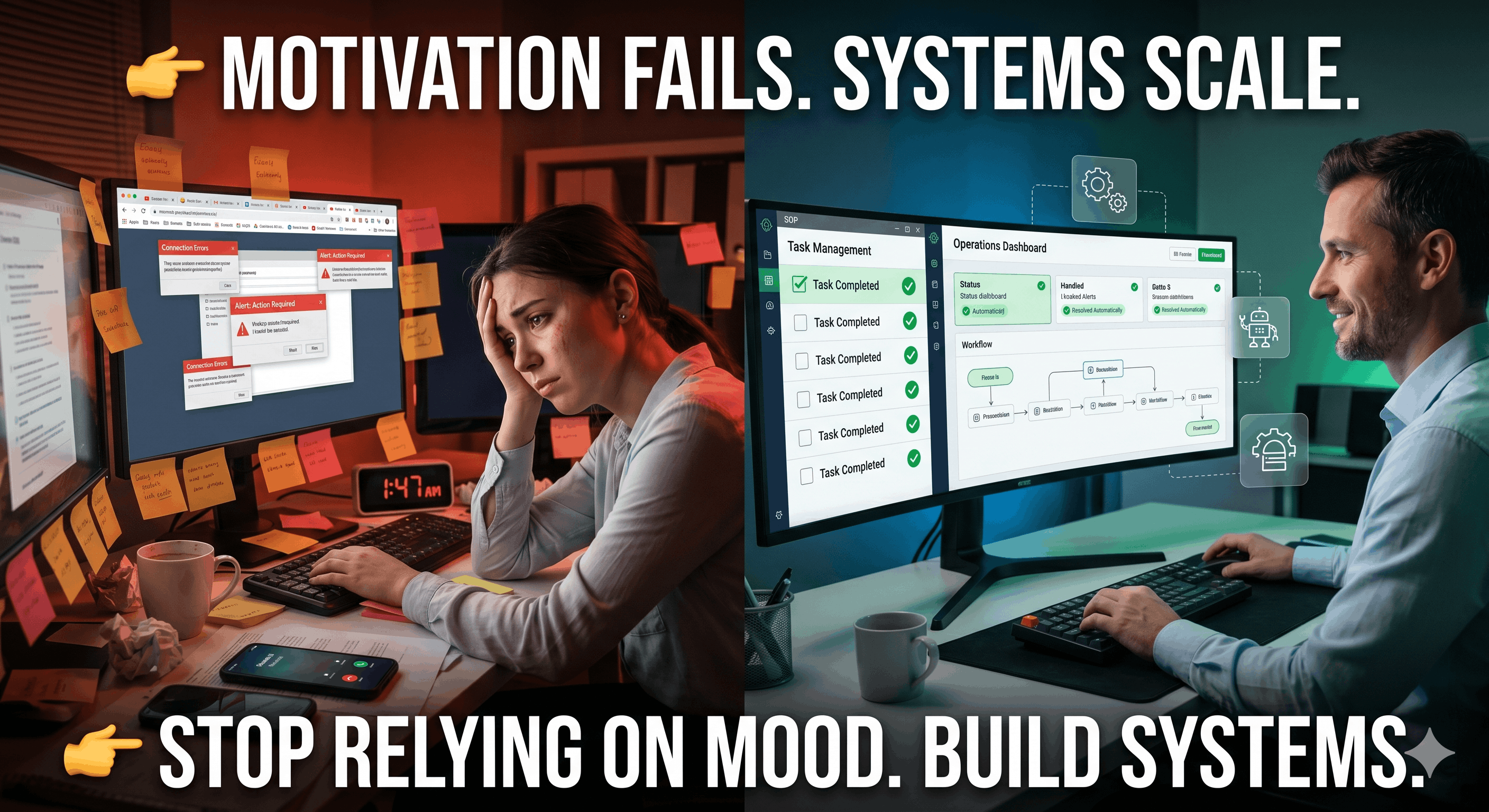
Motivation feels powerful — until it disappears. Emotions fluctuate, but systems scale.
Most projects start with high energy and big plans. Late-night discussions about “this time we’ll do it properly.” But three weeks later, everything slows down. Not because of laziness, but because motivation is a bad engine for long-term execution.
"We do not rise to the level of our goals. We fall to the level of our systems." — James Clear
The Failure of "Feeling Like It"
Dependence on mood is dangerous in IT operations, trading systems, or business support. You cannot say, “Let’s feel motivated before taking critical backups.” A system makes the right action the default, not a difficult choice based on willpower.
What a System Actually Is
- ✅Repeatable Process: No guessing the next step.
- ✅Defined SOPs: Standard Operating Procedures that work 24/7.
- ✅Decision Support: Removing fatigue from daily choices.
Why Operations Need Systems
1. Systems Create Consistency
An SOP ensures the same quality whether an engineer is fresh on Monday morning or tired on Friday night. Processes don't have bad days.
2. Systems Reduce Decision Fatigue
When steps are predefined, stress drops. You don't ask "Is this urgent?" because the system has already categorized the priority.
3. Systems Scale, People Don’t
New team members don't need inspiration—they need clarity. A good system allows someone to plug in and perform within days.
How to Start Today:
- 1️⃣Identify one recurring pain point.
- 2️⃣Write the smallest possible checklist for it.
- 3️⃣Automate one manual step in that process.
- 4️⃣Review the outcome monthly.
Closing Thought
Motivation is for building the machine; the machine (system) should run the business. If your growth depends on constant pushing, you're one bad week away from collapse. Systems allow you to compound quietly.
Need Operational Clarity?
If your business runs on chaos and firefighting, let's build the checklists and SOPs you need to scale.
🔍 Request a Systems Audit