
Recharge Compulsory for Incoming Calls? Are Telecom Policies Hurting Indian Consumers?
Published on • Updated Feb 2026 • By Nitin Pawar • 6 min read
🟡 Update: Issue Now Raised in Parliament (Feb 2026)
Last month when we published this analysis, the issue of compulsory recharge just to keep incoming calls active was mostly a consumer frustration.
Mobile connectivity today is essential for banking OTPs, business communication, and emergency contact — making the incoming-call policy a matter of public importance.
In February 2026, the topic entered national discussion after AAP MP Raghav Chadha raised strong concerns in Parliament about telecom operators forcing users to pay just for incoming connectivity.
The concern raised in Parliament mirrors what many users have been experiencing — that basic incoming connectivity should not depend entirely on mandatory recharge.
This development confirms that the problem is not just a personal inconvenience — it is now recognized as a broader consumer-rights and digital access issue at the highest level.
(This article was originally written on Jan 20, 2026. The original analysis follows below, which is now even more relevant given the recent parliamentary discussion.)
A mobile phone in India is no longer just a calling device. It powers banking, business communication, OTP logins, emergency contact, and daily life.
Yet almost every mobile user faces a silent rule:
No recharge means incoming calls stop. After a short period, the SIM gets deactivated. Eventually, the number is recycled.
The question is simple:
Should access to communication — a basic necessity — become a “pay or lose” system?
The Old System — Consumer Friendly
- Recharge expired → Outgoing stopped
- Incoming calls still worked
- Number remained safe
If someone called you during an emergency, the call connected.
If you weren’t using services, outgoing could stop — but staying reachable remained a basic necessity.
The Current System — Pay or Disconnect
- Plan expires → Short grace period
- Incoming calls also stop
- ~90 days inactivity → SIM deactivated
- Number reassigned
Many users report that incoming calls stopped after recharge expiry, even if they did not require data or outgoing services.
No recharge = No communication.
This is not just inconvenience — it is a safety risk.
Emergency Scenario — A Real Risk
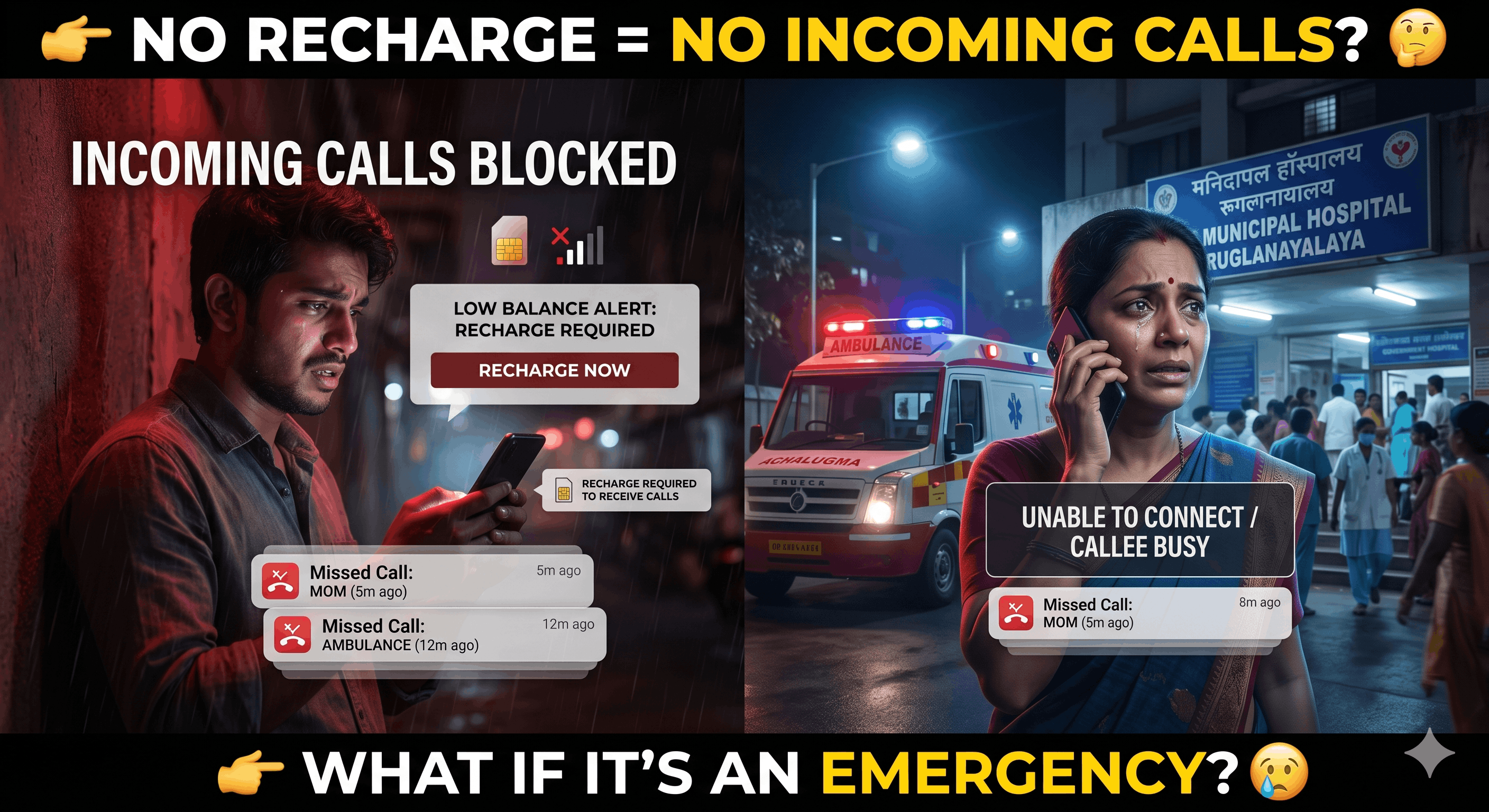
Imagine your recharge has expired. Someone has saved you as an emergency contact. An accident happens. They try calling you.
The call does not connect.
In emergencies, every second matters. Delays can cost lives. This makes compulsory recharge not just a telecom policy — but a public safety concern.
Where Is Consumer Choice?
India’s telecom space is dominated by two major players. Limited competition has led to:
- Higher plan prices
- Mandatory validity packs
- Forced minimum recharges
Use the service or not — payment is still required.
This limits real consumer freedom.
Company Logic vs Consumer Reality
Telecom operators argue that unused numbers must be deactivated to manage network resources.
That is partly valid. But a key question remains:
Why is emergency-level incoming connectivity not protected?
Global telecom frameworks already support minimal incoming-only connectivity models. In India, strong consumer-protection regulation in this area is still missing.
Hidden Risk — Number Recycling
When a number is reassigned:
- Old banking and app links may remain active
- OTP messages can reach a new user
- Identity and privacy risks increase
This turns a recharge policy into a cybersecurity issue.
A Question to the System
If:
- Emergency services (112) are free
- Electricity is a basic right
- Water is an essential service
Why is basic incoming communication not protected the same way?
A simple rule allowing emergency incoming connectivity could impact thousands of lives.
Final Thought
The current compulsory recharge system:
- Guarantees revenue for telecom companies
- Restricts consumer choice
- Introduces safety and privacy risks
Communication must be treated as a necessity — not a luxury.
When policy discussions begin in Parliament after public frustration, it shows how critical awareness is. This issue affects every mobile user in India — and the conversation has only just started.
✍ Written by: Nitin Pawar
Related Analysis on Digital India & Policy:
Do you believe communication is a basic right?
This affects every Indian citizen. Share this post. Awareness is the first step toward change.
Explore Our Digital Trust AuditRead Previous Article